
Carroll County Court Records After a Jail Arrest
After an arrest in Carroll County, booking normally routes through the Carroll County Jail at 6499 W 100 N in Delphi if the person is held locally. The booking record can show the arrest date, booking number, arresting agency, holds, and case sections in the Indiana County Jail Public Portal. The court record is separate. It begins when the Carroll County Prosecutor reviews the incident and files the formal charge or charges in court.
The sheriff's roster is the custody side of the event. Use jail inmate records for the roster, booking status, holds, and jail release questions. Use jail mugshots for booking-photo access limits. Court records after an arrest are searched through Indiana MyCase, with official copies and certified records handled by the Carroll County Clerk. MyCase itself warns that online information is not the official court record.
How to Find Carroll County Court Records After an Arrest
The primary court search channel is Indiana MyCase. The Carroll County Clerk page also directs users to MyCase and says cases can be searched by UTT or citation number or by name. For traffic matters, the Clerk notes that tickets may take 3 to 5 business days to appear. Criminal filings can also lag behind a booking, because the prosecutor has to review and file charges before a public case summary exists.
- Open MyCase and choose the Name search when no case number is known.
- Enter the last and first name exactly as it appears in the jail portal if available.
- Use the Court filter to narrow to Carroll County courts when the arrest is local.
- Use the Case tab for a citation, UTT, case number, or cross-reference number.
- Open the case summary and review charges, bonds, parties, hearings, chronological case summary entries, and linked documents.
- Contact the Carroll County Clerk at (765) 564-4485 for official or certified copies.
The Indiana Judicial Branch MyCase help page explains that public access covers non-confidential, non-sealed, non-expunged cases and that some documents are not linked online even when they may be public through the clerk.
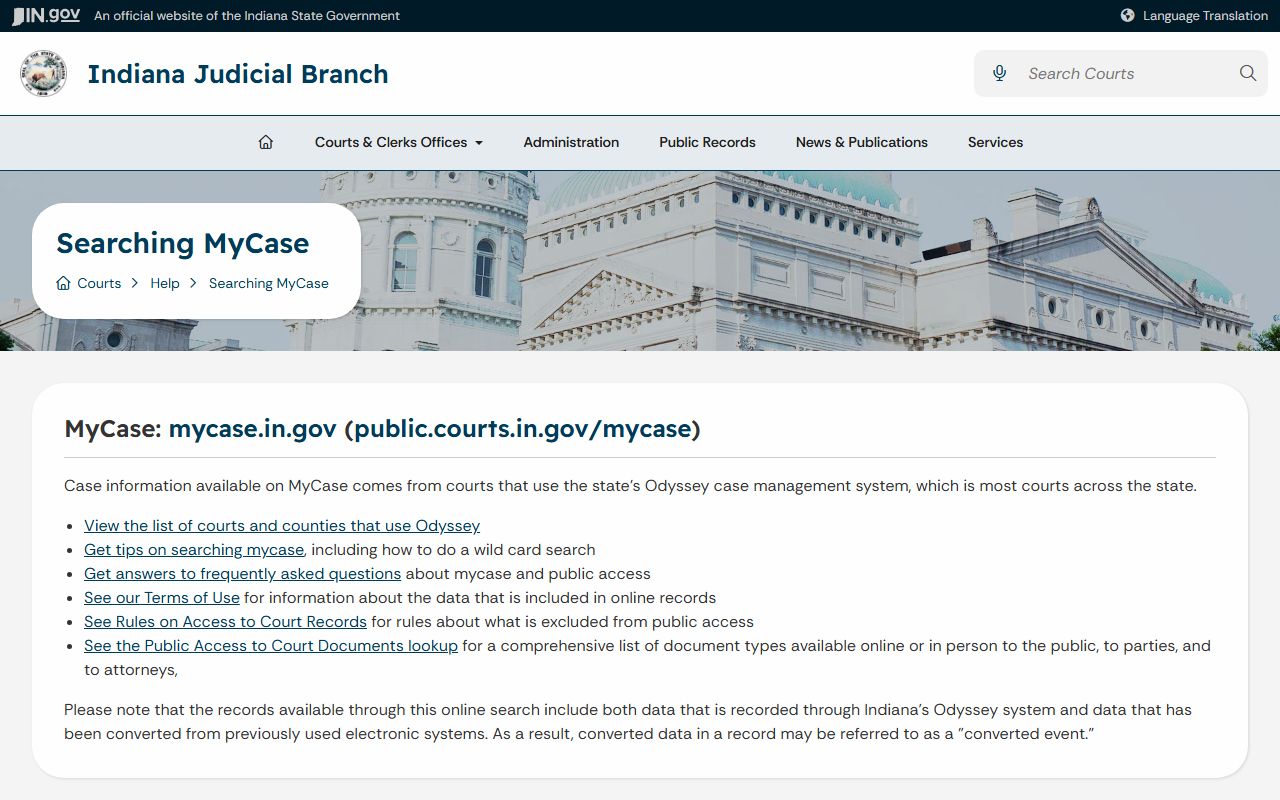
The MyCase help source matters because Carroll County court records after a jail arrest can be searchable online without every court document being downloadable from the case summary.
Arrest to Court Record Pathway in Carroll County
The arrest-to-court path has several handoffs. Each handoff can create a different public record, and the timing is not identical across the jail roster, MyCase, the Clerk, and the prosecutor's charging decision.
- Arrest and booking create the jail-side record, which can include the booking number, arrest date, arresting agency, holds, and case sections in INjail.
- Initial hearing follows Indiana timing rules. IC 35-33-7-1 requires a warrantless arrestee to be taken promptly before a judicial officer, with additional timing rules if bail is posted first.
- The Carroll County Prosecutor reviews the arrest and decides what formal charges to file, if any.
- Once a non-confidential case is filed, it can appear in MyCase with charges, bonds, parties, hearings, chronological case summary entries, and document links when available.
- The Carroll County Clerk remains the official-record route for certified copies, documents not linked online, and current financial information.
- For jail, arrest, and booking records that are not court filings, Indiana APRA and the sheriff records-request process are the public-records route, subject to exemptions and confidentiality rules.
MyCase Search Fields for Court Records After an Arrest
MyCase has several search paths. A name search is usually the starting point after a Carroll County jail arrest, while the case-number and citation fields help when a jail record, traffic citation, or clerk notice provides a specific identifier. Repeated or broad searches may trigger a captcha, and MyCase states that data mining is not allowed.
| Field Label | Type | Required | Options / Format Notes |
|---|---|---|---|
| Case Number | Text | No | Case tab; use when the court case number is known. |
| Citation Number | Text | No | Case tab; useful for traffic arrests or UTT numbers. |
| Cross Reference Number | Text | No | Case tab; narrows searches when that reference is available. |
| Last, First, Middle | Text | No | Name search; start with last and first name, then add middle if needed. |
| Birth Date | Date | No | Name search; useful for common names. |
| Business / Organization Name | Text | No | Business party search. |
| Attorney Name or Bar Number | Text | No | Attorney search path. |
| Court | Dropdown | No | Shared filter; can narrow to Carroll County courts. |
| Sounds-like | Checkbox | No | Helps with spelling variations in party or attorney searches. |
| Status | Radio | No | All, Open, or Closed. |
| File Date From / To | Date fields | No | Advanced Search Options, formatted as mm/dd/yyyy. |
How Charges Get Filed After an Arrest: Complaint, Information, and Indictment
Indiana uses county prosecuting attorneys rather than district attorneys. In Carroll County, Prosecuting Attorney Nicholas McLeland's office handles criminal, juvenile, and traffic matters from the courthouse at 101 W Main St in Delphi. A jail booking may list an arrest reason or preliminary charge, but the court charge is the formal accusation filed by the prosecutor or, in less common cases, by grand jury indictment.
The Carroll County Prosecutor page identifies the local office that reviews arrests and files criminal, juvenile, and traffic matters in court.
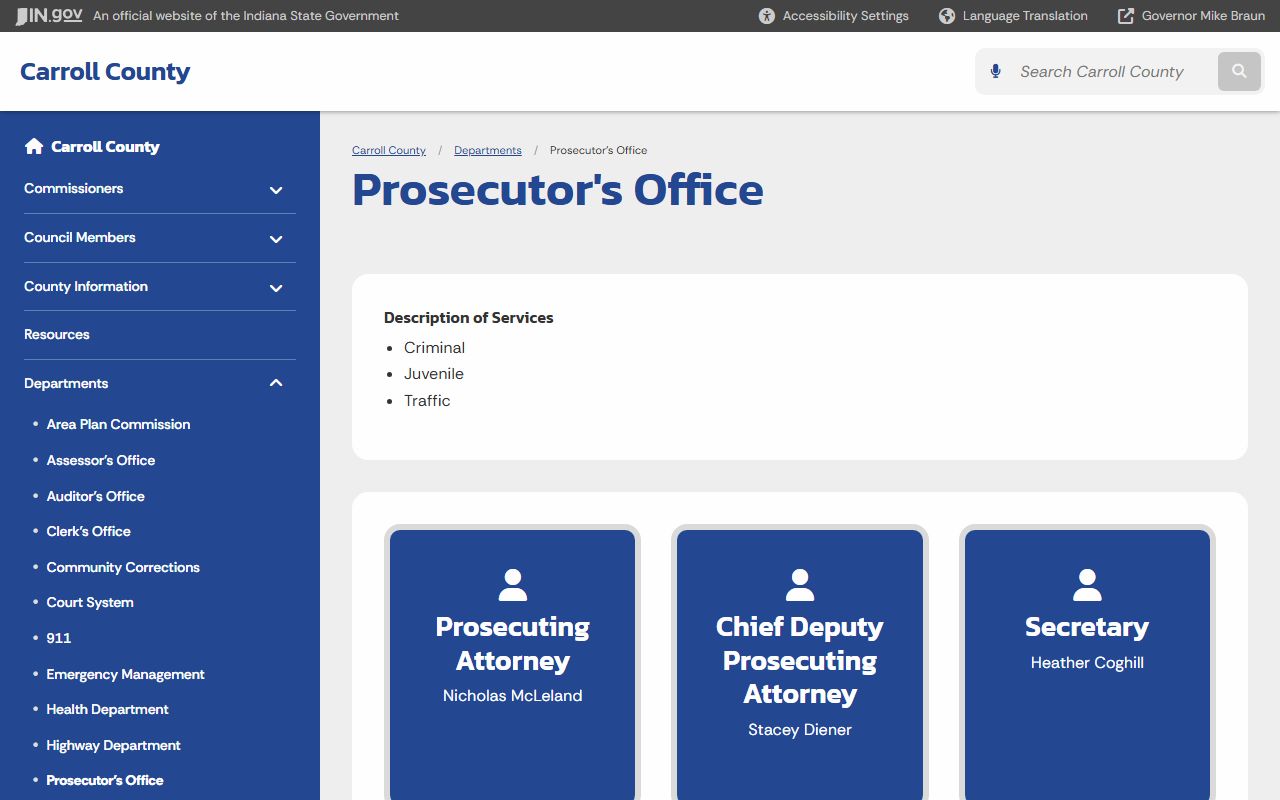
That prosecutor channel explains why a charge shown at booking can differ from the charge later shown in a Carroll County court record.
| Complaint | Information | Indictment | |
|---|---|---|---|
| Filed By | Officer or prosecutor, depending on the process. | Prosecutor. | Grand jury. |
| Common For | Initial sworn allegations or cases started from law-enforcement reports. | Many Indiana criminal cases after prosecutor review. | Serious felony matters where grand jury charging is used. |
| Starts | A court case or criminal process. | The formal court accusation. | The formal court accusation. |
| Why It Matters | May reflect early probable-cause allegations. | Usually shows what the prosecutor chose to file. | Shows grand jury authorization of charges. |
Charge Status and What It Means
Charges change as a case moves through court. A Carroll County jail roster charge is an arrest or booking allegation and is not proof of guilt. A prosecutor-filed charge in MyCase is the court accusation, and the final result can be different from both the original arrest language and the first filed count. Always read the status of each count, not just the case title.
| Status | What It Means |
|---|---|
| Pending | The charge has been filed and has not been finally resolved. |
| Amended | The original charge or charging document was changed. |
| Reduced | The count was changed to a lower offense or level. |
| Dismissed | The charge ended without a conviction on that count. |
| Convicted / judgment entered | The court entered guilt by plea, verdict, or judgment. |
| Deferred / diversion | Prosecution or judgment may be delayed or conditioned, depending on the docket. |
| Warrant issued | The court issued a warrant, often after failure to appear or another case event. |
| Sentenced | The court imposed sentence; an Indiana prison sentence can route the person to IDOC. |
Bond and Release After an Arrest
Bond starts in the court process but is carried out through the jail when release is authorized. Indiana Code 35-33-7-1 requires a person arrested without a warrant to be taken promptly before a judicial officer, with statutory timing rules if bail is posted before that hearing. Indiana bail rules allow courts to consider risk, safety, bail guidelines, and release conditions.
Carroll County's sheriff bond page states that internet bonds are no longer accepted. To bond someone out, the person posting bond must go to the Sheriff's Office with the correct amount. Cash and credit card are accepted. Cashier's checks and money orders are not accepted for bond. A hold, detainer, probation or parole issue, warrant from another jurisdiction, or no-bond order can keep someone in custody even if local bond is addressed.
| Bond Type | How It Works |
|---|---|
| Cash Bond | Money paid directly; the Carroll sheriff accepts cash at the office. |
| Credit Card Payment | The sheriff accepts credit card payments at the office for bond. |
| Surety Bond | A bail agent or surety backs the bond when that form is ordered or available. |
| Personal Recognizance | Release by promise to appear when the court grants non-money release. |
| No-Bond Hold | Release is not available until court or agency action changes the hold. |
Warrants That Lead to an Arrest
No official Carroll County online active criminal warrant search was found on the sheriff site. The sheriff has a Tax Warrants page, but that is an Indiana Department of Revenue payment page, not a criminal arrest-warrant lookup. If a warrant led to booking, the person may appear in INjail. If a public case has a warrant attached, MyCase may show an active-warrant indicator on the party or case summary.
For warrant-related records, use the Sheriff's Office non-emergency route at (765) 822-2166 Ext. 1, dispatch at (765) 564-2413 for calls requiring deputy response, the Carroll County Clerk at (765) 564-4485 for court-file lookup questions, or a specific public-records request where APRA and court-access rules allow release.
Charges vs. Convictions
An arrest, booking, or filed charge is not a conviction. The jail roster may show why a person was booked, and MyCase may show prosecutor-filed counts, but a conviction happens only after a plea, verdict, or judgment. This distinction is especially important for background screening, housing decisions, employment decisions, and any other use where federal or state consumer-reporting rules may apply.
| Charge | Conviction | |
|---|---|---|
| Stage | Accusation after arrest or prosecutor filing. | Final guilt finding by plea, verdict, or judgment. |
| Burden of Proof | Based on probable cause or filed allegation. | Beyond a reasonable doubt in a criminal case. |
| Public Record | Often public if non-confidential and not sealed or expunged. | Often public unless restricted by law or expungement. |
| Can Change | Can be amended, reduced, added, dismissed, or diverted. | Can be affected by appeal, post-conviction action, or expungement law. |
Sealed vs. Expunged Arrest Records
Indiana law allows certain arrests, charges, juvenile allegations, acquittals, dismissals, vacated convictions, or arrests where no charges were filed to be expunged or sealed from public access under IC 35-38-9-1. MyCase can remove granted expungements from public access depending on the type of order. That does not mean every record is destroyed or unavailable to courts and criminal justice agencies.
| Sealed | Expunged | |
|---|---|---|
| Visibility | Hidden from ordinary public access. | Removed or restricted from public access under the expungement order. |
| Law Enforcement | May remain available to courts or criminal justice agencies. | May remain available in limited ways depending on Indiana law and the order. |
| Eligibility | Depends on the case type, disposition, and court order. | Includes certain non-conviction arrests, dismissed charges, acquittals, vacated convictions, and qualifying juvenile allegations. |
| Where to Ask | Clerk or court maintaining the record. | Clerk, court, or legal counsel for the expungement process. |
Background Check Considerations
Casual MyCase or jail roster searches are not the same as a compliant background check. Indiana State Police Limited Criminal History is a statewide channel for Indiana felony and Class A misdemeanor arrest information, subject to state-system limits and fees. MyCase is a public court-information portal, while INjail is a custody and booking portal. Neither should be treated as complete proof of criminal-history status.
Important: Carroll County Inmate Population is not a consumer reporting agency, and its information may not be used for FCRA-covered screening.
Restricted Court Records After an Arrest in Carroll County
Some records will not appear online. MyCase says confidential case types, sealed cases, expunged cases, some older cases, certain protection-order materials, and some document links may be unavailable to the public. APRA also allows or requires limits for confidential, juvenile, investigatory, medical, victim-protected, sealed, or expunged records. If a Carroll County court record should exist but does not appear online, the Clerk is the official-record channel.
The Carroll County Clerk page is the local route for MyCase guidance, payment information, and official court-record questions.
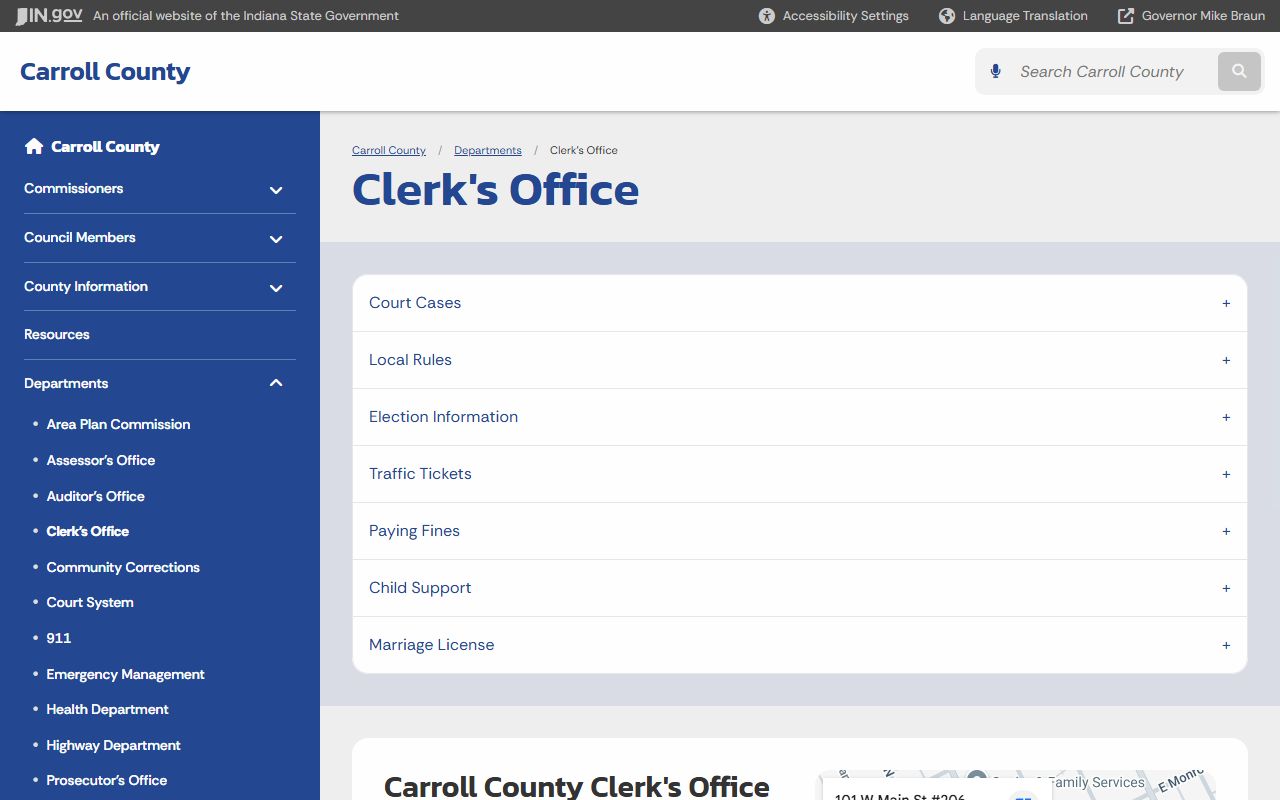
The clerk source is the fallback when MyCase has no document link, when a certified copy is needed, or when a search after a recent arrest is too early to show a filed case.